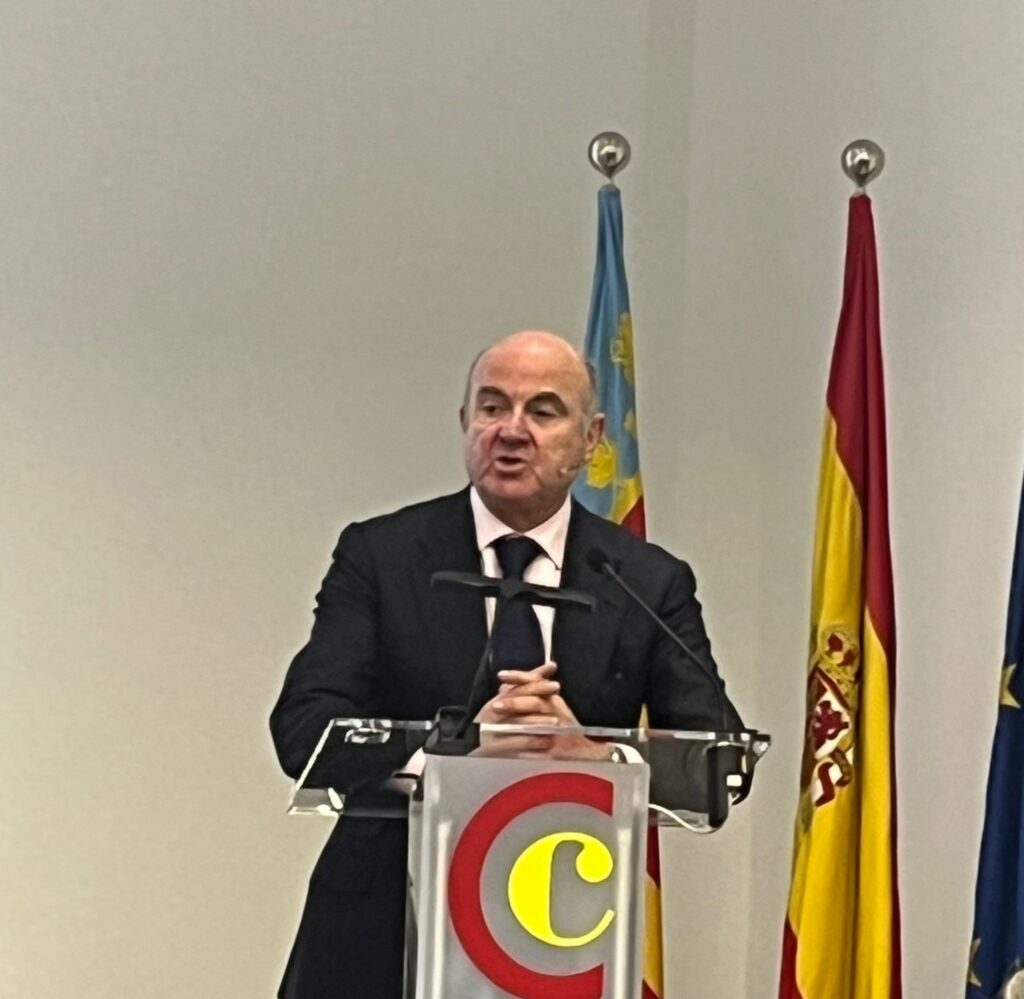
Our colleague Iñaki Soria attended the conference “Present and Future of the European Economy”, organized by Cámara Valencia. The event focused on analyzing the current economic context and its impact on global trade, and featured a keynote intervention by Luis de Guindos, Vice President of the European Central Bank (ECB).
His speech highlighted several factors that are reshaping the European economic landscape and directly affecting the business environment.
The European economic outlook and international trade flows
Europe is at a crossroads shaped by a new balance among major economic blocs. In this context, De Guindos explained that new challenges and opportunities are emerging:
- The search for alternative markets to diversify trade risks and strengthen economic resilience.
- The growing influence of political and economic decisions made by major trade blocs, which affect market access, supply chains, and investment.
- Spain’s role in shaping the European agenda, with a direct impact on financing, competitiveness, and the international expansion of our companies.
Understanding these dynamics is essential for organizations operating in an increasingly interconnected economic environment.
The digital euro and the push for a European payment system
De Guindos also defended the development of the digital euro as a key tool to strengthen Europe’s economic autonomy. Currently, a large share of digital transactions in Europe relies on infrastructures and technology providers outside the European Union, particularly from the United States.
In contrast, according to De Guindos, the digital euro could offer a strong European alternative for digital payments, potentially enabling systems similar to Bizum, but on a European scale.
The project, expected toward the end of the decade, aims to create a secure and accessible payment method managed by the ECB, without associated interest, in order to avoid risks to financial stability.
In addition, De Guindos emphasized that Europe must advance in economic integration, technological innovation, and cybersecurity if it wants to maintain its global relevance alongside powers such as the United States and China.
Staying informed to provide better advice
At Kaizen Consulting, we closely follow the evolution of the European economic and regulatory landscape in order to anticipate developments and provide our clients with financial advisory services aligned with the real context. Our goal is to help them understand how these changes may impact markets, payment systems, and business opportunities within the European financial environment.